Why is France arming Armenia?
 Tigran Yegavian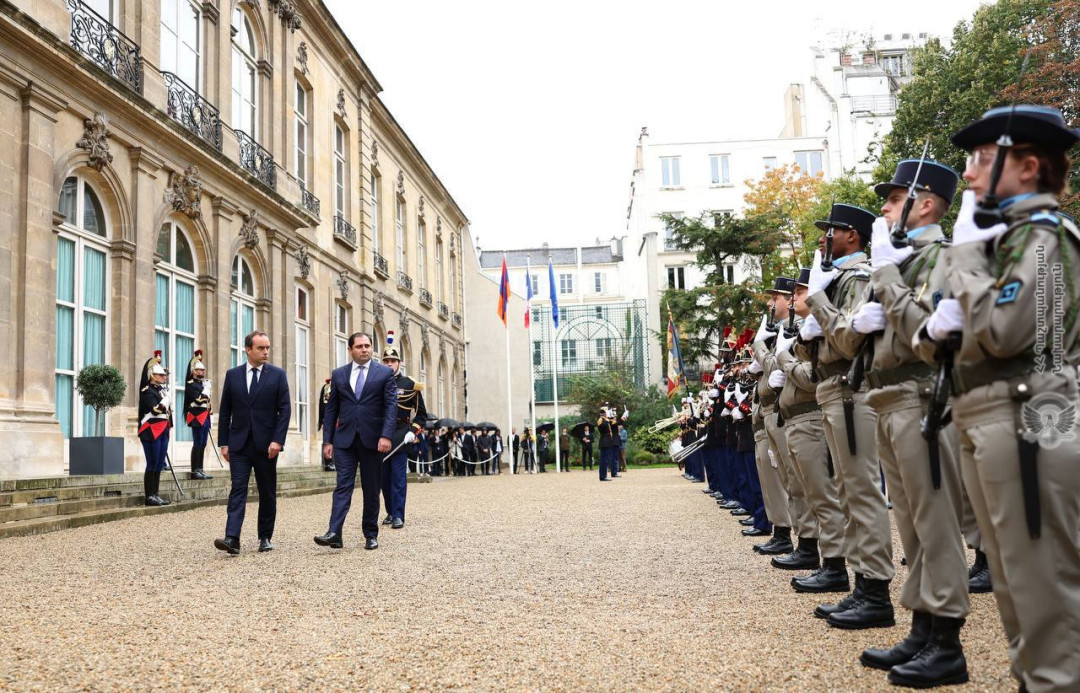
On October 23, French Defense Minister Sébastien Lecornu officially announced the sale of a number of weapons to Armenia. These are purely defensive weapons designed to protect the territorial integrity of the Republic of Armenia, as well as the inviolability of its airspace. Yerevan has signed a contract with France's Thales, as well as a letter of intent with European missile manufacturer MBDA. The contract covers the purchase of three Ground Master (GM200) radars from Thales, Lecornu said at a press conference with his Armenian counterpart, Suren Papikyan, without disclosing the dollar amount of the deal. This medium-range radar, already supplied to Ukraine, "provides remarkable detection capabilities", said Lecornu. It can detect enemy aircraft at 250 km, whether they are flying at low speed and low altitude, like drones, or at high altitude, like combat aircraft.
France has also agreed to train Armenian army officers and non-commissioned officers and to extend its military cooperation in the fields of mountain combat and precision shooting.
In short, France will give Armenia the means to defend itself. Hence Lecornu’s statement: "to defend oneself and one's population."But have we entered a new phase in French-Armenian relations? There's no doubt that France, an age-old friend of Armenia, showed sincere solidarity with the Armenian nation during the 44-day war. In 2021, the French Parliament passed a resolution calling on the government to recognize the Republic of Artsakh. Over the past three years, the number of visits to Armenia by senior French politicians has grown steadily. But is it appropriate to describe France as an ally, given that the term "friendship," however sincere, has no translation in the language of international relations?
What kind of security architecture?
There is every reason to believe that the context created by the conflict in Ukraine is reshuffling the deck. This conflict has regional and global dimensions. The world is currently facing a triple crisis in the Euro-Mediterranean and Caucasian perimeters. Russia's invasion of Ukraine has undoubtedly opened the door to Azerbaijan's final aggression on Artsakh and the annihilation of this unrecognized republic, as well as to Hamas' aggression against Israel. This situation is symptomatic of a security vacuum caused by the absence of a referee, a balancing power. Faced with this multiplication of simultaneous crises, the absence of a hegemonic power generates a wave of destabilization that benefits lesser regional players. Thus, Azerbaijan has plenty of time to launch an offensive on Armenia's borders, knowing that a preoccupied Iran will be far too busy facing the threat of an American-Israeli punitive operation. This tangle of crises, or even "linkage politics" as the American political scientist James Rosenau calls it, theorizes the logic of links between different crises ("penetrating" links, "reactive" links), demonstrating the evidence of a contagion and communicating effect.
In Armenia, France is seen as a lifeline, as the Armenian leadership has taken note of Russia's abandonment of any guarantee of military assistance. Paris is aware of this, hence its intention to secure Armenian territory with means that, though limited, could lay the foundations for a new security architecture for Yerevan.
Clearly, this assistance will not solve all of Armenia's urgent, existential problems. The timing is not right, and it will take years for a new military doctrine to become operational. It will take time for officers and middle-ranking officers to assimilate to the new techniques appropriate to Armenia's terrain and contend with the difficulty of guarding a border with Azerbaijan that has expanded by several hundred kilometers. It is time for the Armenian defense industry to develop in areas where it can add value and find outlets.
But France, weakened by its inexorable economic decline and with its diplomacy struggling to make itself heard, is not able to contribute to the elaboration of a military doctrine in a matter of weeks if not months. It is interesting to observe the way in which Azerbaijan has established itself as a non-aligned, neutral power, refusing to join any collective security organization, be it NATO or the CSTO, while taking advantage of its geostrategic position to raise the stakes as high as possible and assert itself as a neutral armed power.
In an increasingly dangerous world, where the term "alliance" is losing its relevance, France has everything to gain by perceiving Armenia –a democracy, an enthusiastic member of the international organization of the Francophonie – as a reliable partner and a country that can relay its influence in the region, and by moving away from a simple bilateral logic. It is no longer a question of aligning with one power or another, but of multi-aligning according to the interests of the moment. This is a policy that India has been successfully experimenting with since Prime Minister Narendra Modi came to power.
Armenia has everything to gain by positioning itself at the heart of a geo-strategic axis linking France and India, two geo-strategic partners since the 1960s. It is to be hoped that in Yerevan, the employees of the Ministries of Foreign Affairs and Defense will shoulder their responsibilities by putting aside their frustrations with Russia and practicing responsible multi-alignment. The aim is to make Armenia a neutral country, armed by Russia, France, and India.
Tigran Yegavian is a journalist and professor of international relations at the Schiller International University, Paris.
Topic




 Stories