 Civilnet

Gevorg Tosunyan
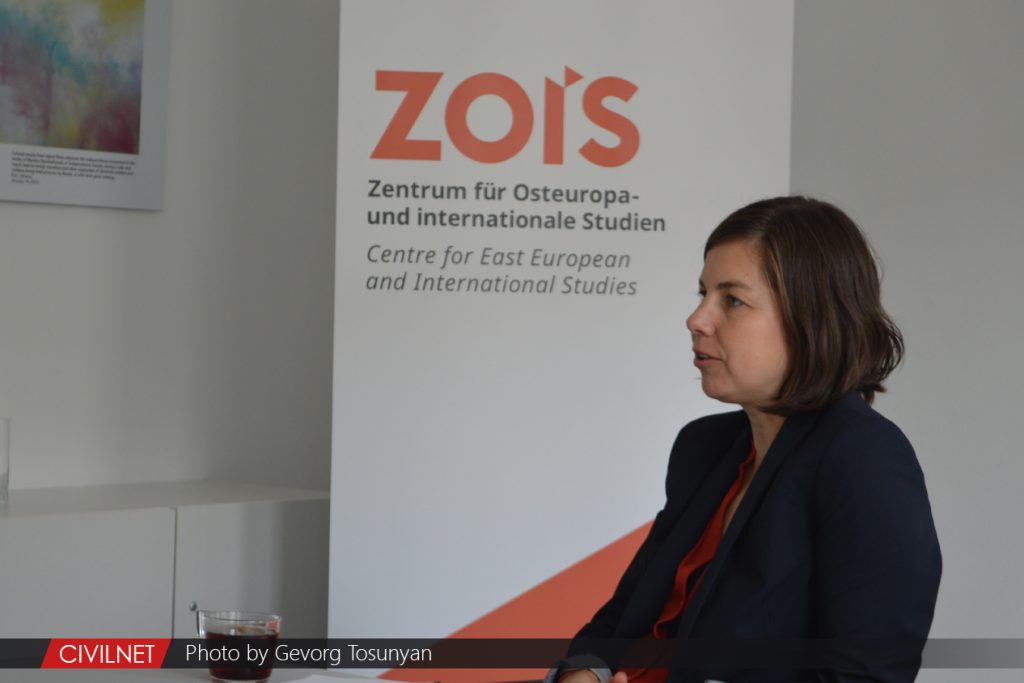
CivilNet has discussed a range of topics, including Armenia-Azerbaijan relations and the Nagorno-Karabakh conflict, with political scientist and researcher at the Centre for East European and International Studies (ZOiS) Dr. Nadja Douglas.
Nadja Douglas holds a PhD from Humboldt-Universität zu Berlin and a master’s degree in international relations from Sciences Po Paris. She also held positions at the International Secretariat of the Parliamentary Assembly of the OSCE and the Development and Peace Foundation in Bonn. From 2015 to 2016, she was a member of the editorial team of Russland Analysen.
In 2020, you rightly observed that “since 1992, numerous attempts have been made in various rounds of negotiations to bring Armenia and Azerbaijan to a solution of the conflict. Over time, however, it has become increasingly apparent that two fundamental principles of international law—Azerbaijan's territorial integrity, on the one hand, and the right to national self-determination of the people of Nagorno-Karabakh, on the other—are difficult to reconcile”. Has anything changed about these fundamental principles after the war and recent events?
Those principles have always been part of the negotiations around the solution to the conflict. The problem is that neither side has been ready to make concessions. For a long time, Armenia wasn’t ready to hand back the illegally occupied areas, and on the other hand, Azerbaijan was not ready to grant autonomy status to Nagorno-Karabakh. The problem is now that Azerbaijan has created new facts: the seven provinces have been handed back, and Nagorno-Karabakh has become Azerbaijani territory. It would have been now the turn of Azerbaijan to finally provide certain provisions for the special status of Nagorno-Karabakh, but Azerbaijan wasn’t ready to make any concessions in that regard. I believe that if they want to achieve a sustainable peace and they want to live peacefully together in that region, they should, at some point, find a political and peaceful solution. Otherwise, the conflict will nevertheless continue. Hundred thousand people have left Nagorno-Karabakh, but there will always be some Armenians that will remain, and some people will want to return one day once they know that safety can be assured. It should be in the genuine interest of Azerbaijan to negotiate with the representatives of Nagorno-Karabakh to provide them with some sort of status, to grant them minority rights, and to ensure their security. Armenia is ready to negotiate a peace agreement because, despite so many ceasefire agreements, there has never been a peace agreement. But they do it now from a position of weakness. The Pashinyan government is very afraid of losing its territorial integrity. It is a question of the viability of the Armenian state. From that perspective, I assume that they are ready to negotiate a peace agreement with Azerbaijan at least for the sake of securing their external borders and to end all the military attacks by Azerbaijan that have been going on since November 2020. The trilateral ceasefire agreement, which was signed then, is actually not a trilateral but a bilateral agreement since Russia's role in that agreement has been negligible, so this agreement is basically futile, because Russia has not fulfilled its mandate.
Azerbaijan has blocked the Lachin corridor since December, and in September, Azerbaijan claimed full control of the breakaway region. You have addressed this issue in your article “The Significance of the Lachin Corridor in the Nagorno-Karabakh Conflict.” What are Azerbaijan’s long-term plans, and what should Armenia do to overcome this situation?
Many would like to know what Azerbaijan plans in the long run. Obviously, the next project is the so-called Zangezur or Syunik corridor. Azerbaijan had announced earlier that they would like to realize an analogous situation in the Lachin corridor. There is a big fear among Armenians that Azerbaijan could create a corridor with a sort of extra-territorial status and that Azerbaijani forces could overtake complete control of the corridor and the surrounding area. For Azerbaijan, it would mean huge progress because they would eventually achieve a connection for transportation and transit, between western Azerbaijan and Turkey through Nakhichevan. By the way, Nakhichevan is a good example of how Azerbaijan even treats its own autonomous regions. As far as I know, Nakhichevan has no autonomy to speak of anymore because it is completely controlled by the center, by Baku. Even the security services are completely controlled by Baku. But what are the long-term goals? Whether Azerbaijan really wants to decimate Armenian territory or even weaken Armenians even further so that they will not be able to attempt anymore to resettling Nagorno-Karabakh or claim rights for the inhabitants there, is very difficult to say. Many of these aspects should be part of a peace agreement so that Armenians can at least be saved in the future. This is the predominant priority now: that Armenian territorial integrity should be preserved in its internationally recognized brothers. Aliev in the past even questioned Armenia’s state entity as such. So it is very difficult to know what to expect from him in the future.
There is a very popular opinion in Armenian society that not only Turkey and Azerbaijan, but Russia is also interested in this corridor. What is your opinion about this situation?
Yes, I can imagine that Russia is interested in it because Russia is very dependent on Azerbaijan for exporting its own goods, for reaching global markets, etc. Azerbaijan is a very close ally of Turkey, and Turkey is one of the few states that still sort of tolerates what Russia does. However, it is questionable whether any corridor can actually be realized because there are other actors with vested interests as well. It is already to some degree visible that regional actors have diverging ambitions. So there is potential for conflict. Turkey has suggested that the corridor could actually lead across Iran’s territory, which would be a solution to some degree because it would save Armenia. But it is questionable whether Azerbaijan and Iran would agree because Azerbaijan and Iran are not on good terms. I am quite unsure how Iran would react in that situation.



 Stories