Civilnet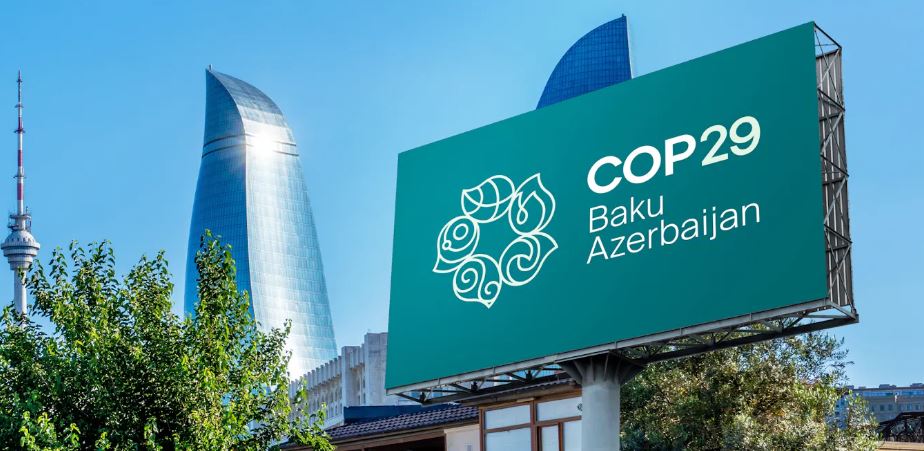
By Sonya Dymova
The United Nations Climate Change Conference, COP29, kicked off in Azerbaijan’s capital Baku on Monday, scheduled to run through November 22. The summit takes place as 2024 is projected to become the hottest year on record yet, beating the record-setting high temperatures of 2023.
Fewer people are expected to attend
Political turmoil as well as boycotts over Azerbaijan’s climate and human rights record have stirred some attendees away. COP29 is expected to host somewhere between 40,000 and 50,000 participants, unlike the COP28 in Dubai which hosted a record 100,000 attendees last year.
Some high-level officials withdrew from the conference, citing other commitments or not providing reasons for the refusal. German Chancellor Olaf Scholz announced he would not attend the conference after his three-party ruling coalition collapsed last week. European Commission President Ursula von der Leyen also reversed her plans to attend COP29, citing the ongoing hearings to confirm her EU’s executive branch team. The world’s top three polluters — China, India and the United States — are not sending their presidents and prime ministers to the conference. Several other world leaders have opted not to attend this year, including French President Emmanuel Macron, Canada’s Justin Trudeau, Russian President Vladimir Putin, Brazilian President Luiz Inácio Lula da Silva and Australia’s Prime Minister Anthony Albanese. The countries are still sending delegations to the conference.
Papua New Guinea’s Prime Minister James Marape announced in August the country would not participate in the summer, citing its frustration over “empty promises and inaction.”
Swedish climate activist Greta Thunberg announced she would not be attending the conference, calling it a “greenwash conference” during a recent lecture and citing the country’s war crimes and oil dependency in an op-ed published by The Guardian. Thunberg described Azerbaijan as “a repressive, occupying state, which has committed ethnic cleansing, and which is continuing cracking down on Azerbaijani civil society.”
Oil and gas account for about half of Azerbaijan’s total economy and over 90% of the country’s exports, raising concerns over Baku's intentions for the conference.
Azerbaijan’s minister of ecology and natural resources and the conference’s chief negotiator Mukhtar Babayev, who assumed the COP29 presidency Monday morning, spent 26 years at Azerbaijan's state-owned oil and gas company Socar before taking up his current political post in 2018. Just days before the launch of the conference, another Azerbaijani and COP29 senior official Elnur Soltanov appeared promoting fossil fuel deals and saying the country has “a lot of gas fields that are to be developed” in a conversation secretly recorded by an advocacy group Global Witness.
Armenia still hasn’t decided whether to participate in COP29, the country’s deputy foreign minister Vahan Kostanyan said in a statement on Monday.
The climate conference, advertised by Azerbaijan as “COP for peace,” launched nearly a year after Azerbaijan drew some 120,000 Armenians out of Nagorno-Karabakh in a move Freedom House and other NGOs deemed ethnic cleansing. Over 23 Armenians are still held prisoners in Baku. According to the local NGOs, more than 300 people are currently imprisoned in the country on politically motivated charges overall.
COP29 will also see first-time attendees. The conference marks the first time the Taliban will attend a UN climate conference since their takeover of Afghanistan in 2021.
What’s on the agenda?
Climate finance is the focus of this year’s conference, with hopes of striking a new deal on how much money wealthy nations will allocate for developing countries to adapt to and curb climate change. Financing compensations for climate disasters, funds for countries to prepare for future extreme weather events, and transitioning their energy sectors from fossil fuels toward clean energy are among the challenges COP29 is looking to address.
The new target is set to replace an existing goal set by wealthy countries 15 years ago, when they pledged to provide $100 billion annually for developing nations, vowing to hit the mark by 2020. They did not reach that target until 2022.
Babayev, speaking at the conference earlier today, called the creation of a new target for funding climate action in developing countries the “top” priority.
“COP29 is a moment of truth for the Paris Agreement,” he added, referring to a landmark accord aiming to limit global warming to no more than 1.5 degrees Celsius (2.7 degrees Fahrenheit) since pre-industrial times.
At the summit, the countries are expected to debate not only the size of the target but also who should be obligated to pitch in. Europe and the U.S. are pushing for a broader contributor base, including China and Middle Eastern petrostates, countries that were not classified as developed when the original climate framework was created.
However, the formal agenda of the conference still has not been set, as nearly 200 countries represented at COP29 spent the first day fighting over what should be prioritized and included in the document.
U.S. climate policy also became a spotlight on the first day of the conference, which launched days after Donald J. Trump’s presidential election victory. America’s president-elect has said he would exit the Paris Climate Agreement in his second term. That would not be the first time: the country formally withdrew from the agreement during Trump’s first term, a decision quickly reversed under President Joe Biden.
John Podesta, the U.S. climate envoy and a key White House adviser to Biden, spoke at the conference today, deeming Trump’s re-election “bitterly disappointing” for those who care about climate action. Still, he sought to reassure the participants.
“But what I want to tell you today is that while the United States federal government, under Donald Trump, may put climate action on the back burner, the work to contain climate change is going to continue in the United States,” Podesta said.

 Stories