OPINION: What Armenia-Azerbaijan Pre-Signed Peace Agreement Reveals
 Narek Sukiasyan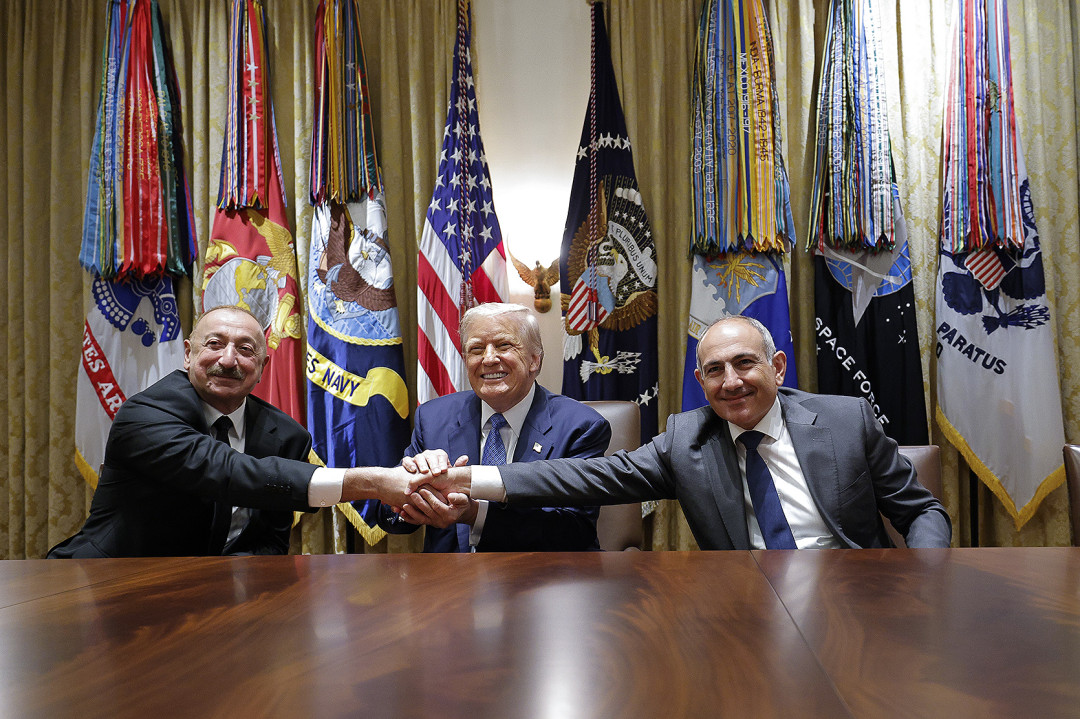
By Narek Sukiasyan
On August 8, Foreign Ministers Ararat Mirzoyan and Jeyhun Bayramov pre-signed the Agreement on Establishment of Peace and Inter-State Relations between the Republic of Armenia and the Republic of Azerbaijan – a peace deal in short. They agreed on the text in March, however the text had been kept secret raising questions of accountability at the cost and need of diplomatic secrecy. This Monday, the sides made the text public.
Before going any further, it is important to emphasize that this document is not a finalized peace treaty. It was only pre-signed at the White House last week and has yet to enter into full force. Signing and ratification is not expected in the near term, and below I explain why.
The text presents a largely standard diplomatic framework, with little extraordinary nuance, although its drafting process took nearly four years. This length is symptomatic not of the complexity of the text, but of the lack of willingness on the part of the sides – particularly Azerbaijan – to advance in talks.
Of particular note, the preamble explicitly references the Almaty Declaration of 21 December 1991, reaffirming respect for Soviet-era borders. This was a point firmly insisted upon by Armenia, while Azerbaijan attempted to omit it, leaving the door open for referencing different Soviet or pre-Soviet era maps in its favour.
Article 7 of the agreement stipulates that, following ratification, third parties – EU monitoring mission along the Armenia-Azerbaijan border – should cease. In earlier stages, Armenia wanted the article to refer to only ‘armed forces’ so that it would not apply to the EU civilian mission. Azerbaijan did not concede. After entering into force EUMA patrols that report to Brussels will stop. In response, Armenia has proposed revising the mandate toward monitoring otherwise and assisting with reforms of the Armenian State Border Service.
Articles 2 and 8 emphasize the renunciation of territorial claims and include a commitment to combat hatred and separatism. Armenia will need to invoke these provisions in the future to counter Azerbaijan’s state-sponsored claims over parts of Armenia, notably the narrative of “Western Azerbaijan.”
Article 12 establishes that domestic laws cannot override the treaty. Through this, Armenia affirms the treaty’s supremacy over its constitution, signaling acceptance that, despite any Azerbaijani claims, Armenia acknowledges the agreement as paramount and confirms it holds no territorial claims on Azerbaijan.
This provision undermines Azerbaijani President Aliyev’s stated precondition that Armenia amend its constitution prior to signing the treaty. Nevertheless, Azerbaijan continues to insist on constitutional changes, that is why the treaty is only a pre-signed document and unlikely to be finalized within one to two years—especially considering Armenia’s scheduled 2026 national elections and a potential constitutional referendum thereafter.
Azerbaijan’s continued insistence on constitutional amendments appears motivated by (its actual) political aims: to delay peace, exert pressure on Armenia, consolidate domestic legitimacy by portraying victory of the dictator, and retain a legal pretext for future conflict should the referendum fail. Considering Aliyev’s loud demands and Pashinyan’s questionable trust levels, it is not hard to imagine the referendum failing. This might become a disaster lurking beneath the surface in the long term.
Article 15 calls for the withdrawal of ongoing legal cases. Armenia’s recent accession to the International Criminal Court and ratification of the Rome Statute, aimed at prosecuting Azerbaijani war crimes and preventing new ones is effectively negated by this clause. This is a high price to pay, not only for reasons of justice and upholding human rights of the victims, but also Armenia joined ICC at the backdrop of the warrant for Putin’s arrest. This led to a diplomatic flare-up between Yerevan and Moscow, at a time when Nagorno Karabakh was still under blockade and Russian peacekeepers were still present. Many argue, Prime Minister Pashinyan’s international legal team resigned in protest to this article in the text of the peace treaty. Nevertheless, to incentivize Azerbaijani commitment, Armenia has stipulated that these cases will be withdrawn only within one month after treaty ratification, thereby ensuring legal actions are not dropped unilaterally prior to formal agreement.
Significantly, the treaty omits several critical issues. There is no mention of Armenian prisoners of war currently held by Azerbaijan, no guarantees concerning the rights of refugees or the right of return, no references to territories still under Azerbaijani occupation—which are deferred to border delimitation commissions—and no provisions for the protection of Armenian cultural heritage in Nagorno-Karabakh.
Among other provisions, the pre-signed treaty foresees the establishment of diplomatic relations between Armenia and Azerbaijan, cooperation across various sectors, ongoing border demarcation efforts, and work on the issue of missing persons. Again, all of this only after the treaty is actually signed and ratified. I leave legal interpretations to lawyers.
While the agreement may contribute to short-term stabilization, it effectively legitimizes Azerbaijan’s prior military aggression by embedding it within legal frameworks. Instead of ensuring accountability for acts of ethnic cleansing, the treaty allows Azerbaijan to evade responsibility and, in effect, glorify its actions. An unjust peace is not sustainable. My enthusiasm is curbed by an evident lack of trust between the sides, especially so, due to Baku’s record of violating agreements, changing terms, adding preconditions, propagating systemic hatred, and well…committing and celebrating ethnic cleansing just recently. When international legal systems crumble before our eyes and the rules-based world has resolutely turned into a power-based world (very much pioneered by the likes of Aliyev and Erdogan) one can only hope for the right alignment of stars and winds for even a signed deal to be upheld.
Narek Sukiasyan is a political science lecturer at the American University of Armenia and a researcher at the Center for Civilization and Cultural Studies at Yerevan State University.



 Stories