Richard Giragosian: Armenia’s New Post-War Strategy
 Civilnet
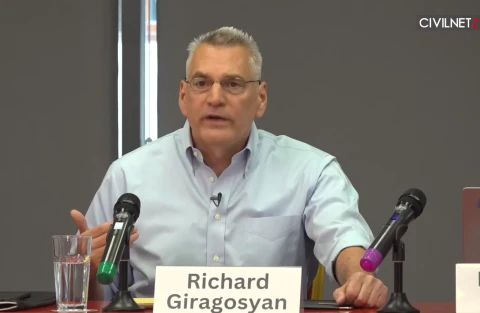
Richard Giragosian, political expert and founding director of the Yerevan-based Regional Studies Center, delivers a lecture on “Armenia’s New Post-War Strategy” at the 2025 Monterey Summer Symposium on Russia. The presentation took place on July 2, 2025, in Yerevan, as part of the symposium organized by the Monterey Initiative in Russian Studies at the Middlebury Institute of International Studies at Monterey. The symposium ran from June 25 to July 13, 2025, in Batumi, Yerevan, and Tbilisi.
Key points from the lecture:
Pre-War Period and the 2020 Conflict: When Prime Minister Pashinyan came to power in 2018 through peaceful revolution, he represented a fundamental shift from previous Armenian leaders who were tied to the Nagorno-Karabakh conflict. Pashinyan viewed the frozen conflict as a burden on Armenia's development and emphasized domestic priorities over nationalist rhetoric. However, his statements like "Nagorno-Karabakh is Armenia" created expectations and subsequent feelings of betrayal in Azerbaijan, contributing to the 2020 war. The 44-day war was militarily unique due to unprecedented Turkish support for Azerbaijan, including drone warfare and air force assistance, and Azerbaijan's limited objective of retaking buffer zones rather than attacking Armenia proper.
War's Impact and Armenia's Response: The most significant casualties of the 2020 war were the end of Armenian arrogance and complacency, and the collapse of deterrence against Azerbaijani military threats. The war established two dangerous precedents that later encouraged Putin's invasion of Ukraine: the validation of force over diplomacy and authoritarian victory over struggling democracy. Despite losing the war, Armenia's government was surprisingly reelected, and there was no crisis of confidence in democracy. Armenia's response involved recognizing the need for compromise, localizing the conflict through bilateral negotiations rather than relying solely on external mediation, and managing Azerbaijan's maximalist position following their first-ever military victory.
Post-War Strategy and New Objectives: Following the complete loss of Nagorno-Karabakh in September 2023 after Azerbaijan's siege and 24-hour military operation, Armenia adopted a new strategy with three main elements. First is diversification of security partnerships beyond the traditional West-Russia framework, looking toward Asia and non-aligned countries. Second is defense reform, transforming the military into a smaller, professional territorial defense force rather than rebuilding for offensive capabilities. Third is establishing a clear end-state objective focused on normalization with neighbors (including Turkey and Azerbaijan), connectivity through reopened borders and trade routes to regain deterrence through economic interdependence, and accepting current borders rather than seeking to retake lost territories. This controversial approach prioritizes overcoming isolation and building "real Armenia" within present borders over military revenge.