2025 Silicon Mountains takes Yerevan with the Theme “Anatomy of AI”
 Civilnet
By Martina Sanna
At the Sustainable Mountains 2025 conference this month, local and international stakeholders gathered in Yerevan to exchange the latest updates from the tech world under a common theme “Anatomy of AI”.
The event took place in Yerevan’s D’vin Music Hall and featured high-level speakers, such as Vincent Roche, CEO of Analog Devices Inc., Andre Adonian, Chairman Emeritus North Asia McKinsey, and Noubar Afeyan, founder and CEO of Flagship Pioneering.
Along with their presentations, the UEICT sponsored project Step AI, which aims to teach Armenian high school students the AI language, was also introduced to the public.
The AI industry has been picking up steam in the country for some time. A recent example is the $500 million project for a new Ndivia AI factory in Armenia. The initiative is meant to give birth to the only AI factory in the entire Caucasus region, giving Armenia a boost in joining the industry. Most of the existing AI factories are currently located in the EU, the U.S., and China.
“AI is a very complicated business,” said UEICT Executive Director Eduard Musayelyan, the organizer of 2025 Silicon Mountains. “Education is a crucial thing we are doing in Armenia. We are trying to spread this innovation not only in the capital but also in the region using a simple language. This is what we are trying to do with Step AI. For now, we have 15 schools involved and we plan to increase the number in the next couple of years. But our goal is to focus on quality, rather than quantity.”
When asked about what kind of support the initiative is receiving from the Armenian government, Musayelyan replied, “The program is supported by the government, but not funded yet. We hope to involve funds also from the government side”
Another remark on the importance of AI education was given by one of the keynote speakers of the day, Vincent Roche, who was visiting Armenia for the first time.
“The foundation of our survival has been our ability to quickly sense, learn and adapt to changes in the world around us, and we are increasingly using AI as a sensing and learning accelerator. As the philosopher Eric Huffer said, in times of change learners inherit the earth, while the learned find themselves beautifully equipped to deal with a world that no longer exists,” he noted.
Noubar Afeyan, best known worldwide for co-founding the biotechnology company Moderna, focused his talk on debunking the fact that humans are the only intelligent being in the universe. He called for the AI industry to widen its field of study to other forms of intelligence in nature, to go beyond the definition of AI as a version of human intelligence emulated by computers.
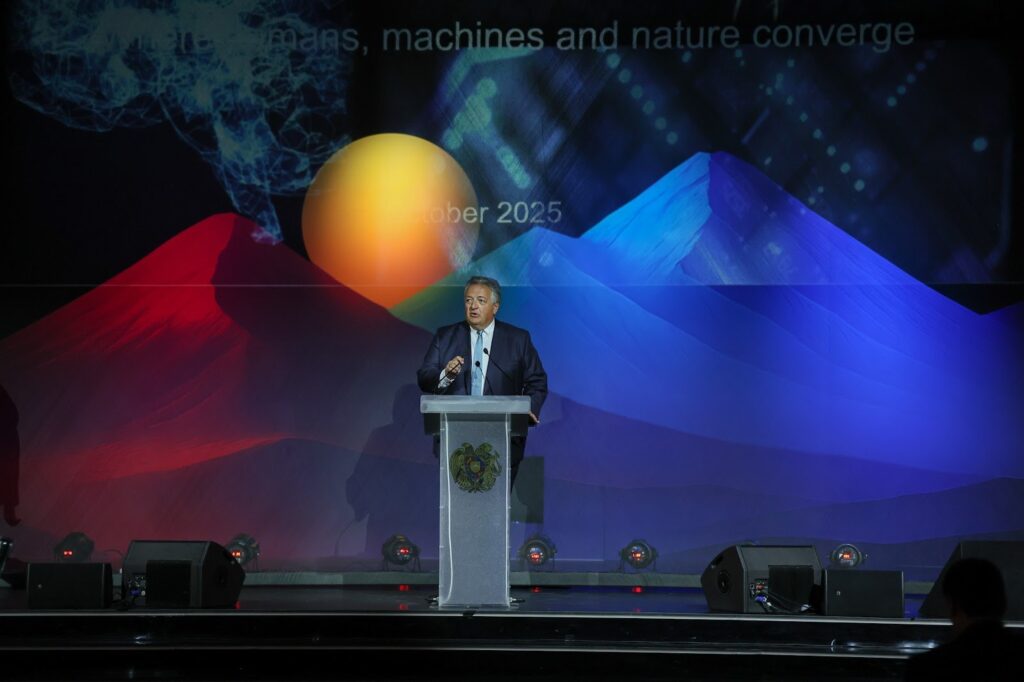
After presenting Lila, a company he co-founded three years ago with the goal of building a so-called Super Intelligence, to better address the main challenges humanity is currently facing, Afeyan concluded with a question to the audience: “What happens if we start thinking about nature as intelligent systems? Do you think a virus is intelligent? If you don’t, how come that a virus with a few bits of RNA code almost took down the human immune system just five years ago? How is it that it knows how to change itself so that the immune system can’t catch it? So, maybe, there is some kind of intelligence there.”
Andre Adonian, Chairman Emeritus North Asia McKinsey, put the focus on a different angle, namely the kind of investments needed to finance the computing power to generate with AI, estimated at $7 tetra for the period 2025-2030. “It is the largest investment done in human history,” he noted.
Adonian’s analysis pointed out the fact that in contrast to before, this investment won’t be predominantly covered by public funds, but by those coming from private companies such as AWS, Meta, Amazon, Microsoft.
“If you look at what those companies have invested until 2022 it’s about a 30% increase in capex. They doubled it over the last three years and they are pretty much keeping this level.” said Adonian “Therefore, as long as they can basically capture those revenues, if nothing unforeseen happens, they will be able to continue financing it.”
Topic





 Stories